Not Your Mother's Tzimmes
A soul-warming stew from the Old Country
When I first started dating Donald in the mid '70s, his Mom used to make dinner for me from time to time, and one evening she served two things I'd never had before -- a salad with Green Goddess dressing, which I thought amazing, and tzimmes. The Green Goddess is a story for another time; tonight I'm writing to tell you about tzimmes.
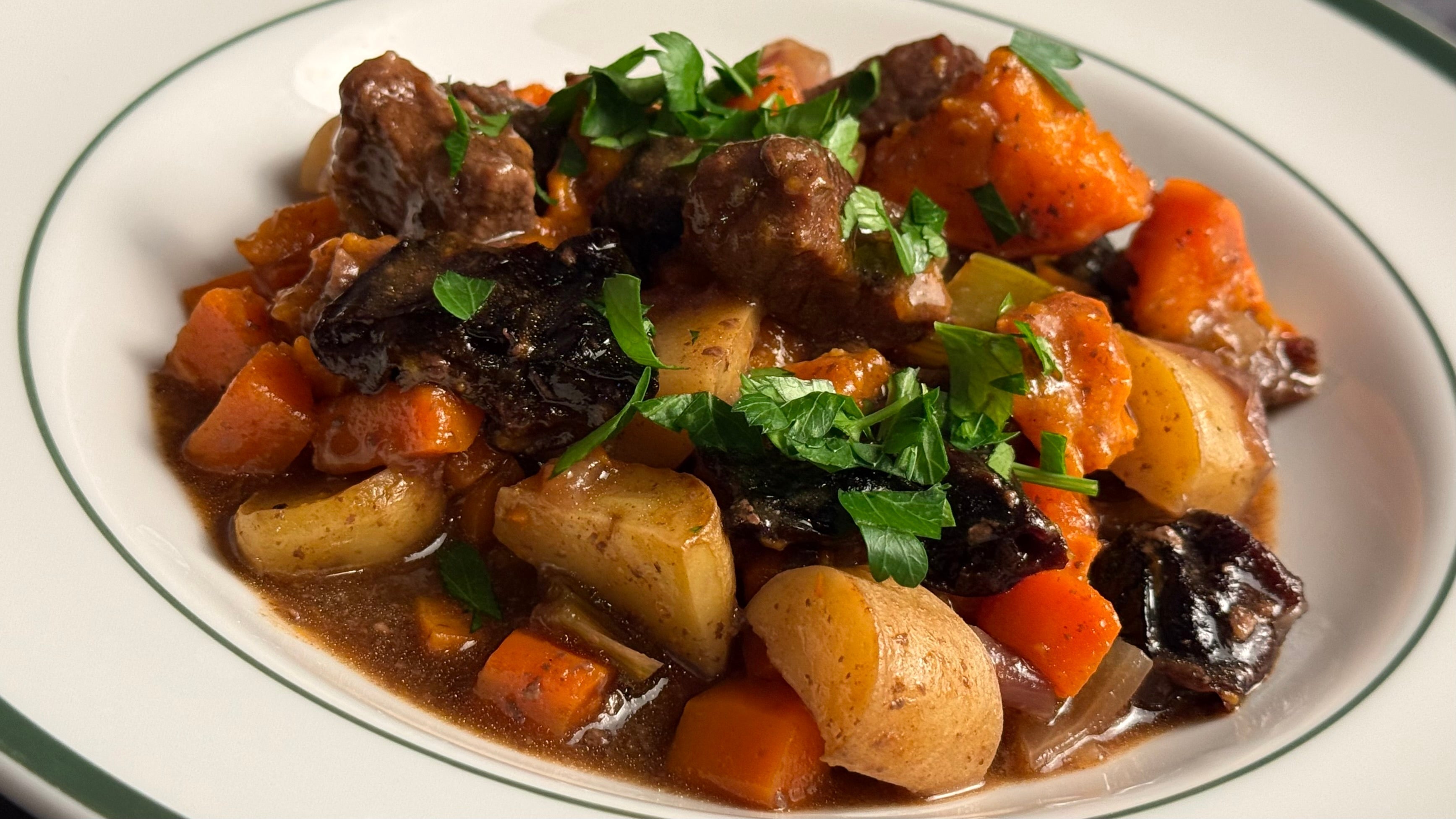
Until that evening, I couldn't have imagined what magic would be made with succulent stewed chuck roast, prunes, and sweet potatoes. Sure, my kama aina Dad would add pineapple to beef for a grilled teriyaki steak-on-a-stick in the summer, but those cubes of alternating salty/dry and sweet/tart morsels were a world away from the voluptuousness of tzimmes glistening on my plate on a cold winter night. Tzimmes is soul food of the highest and most immediate order for me.
My mother-in-law left this world decades ago, but I have Donald to carry on his Mom's cooking for me, albeit with more refined technique and presentation. This is a meal that transports me in communion with centuries of Eastern European hearths. If warms my home, I share it now to warm yours.
Technique Note
Donald typically browns the meat and vegetables first and then braises them in stock when making meat stews, including tzimmes, however, I've recently started using a simpler method which cuts down cooking time.
If you start the braising in a covered pan in the oven without browning the ingredients and then, in order to the flavorful browning from a Maillard reaction), uncover the pan and crank up the oven for an additional 30 minutes or so until the tops of the exposed ingredients brown nicely. With this method it’s important make sure that there is liquid just below the meat before starting the uncovered browning step. If the casserole dish contains too little liquid you'll not have any sauce and the meat could burn. If, after the first step of braising, there isn’t enough liquid just add more before starting the final, uncovered, cooking step.
The original recipe required a cooking time of 2 to 3 hours, however, for this version Donald uncovered the meat after 1.5 hours and, along with the final 30 minutes, found that the meat was tender.
Simplified Tzimmes
Here is our simplified tzimmes recipe along with the addition of some spiced wine for seasonal zing and some cornstarch for glossiness.
Preheat oven to 300° F
In a saucepan over medium heat add 1/2 cup of red wine with a 1 inch piece of cinnamon stick Add a 2 cloves if you have them. Reduce to 1/4 cup and set aside.
In a small bowl, add 1 Tbsp of corn starch and 2 Tbsp of water. Mix to combine.
- In a oven proof pan large enough to hold all the ingredients add the meat, stock, celery, carrots, onions, cinnamon stick and stock. Cover with foil and bake for 1.5 hours or until the meat is fork tender.
- Uncover the pan and turn the oven up to 400° F. Add the prunes, sweet and yellow potatoes, and 1/2 inch rounds of carrot to the pan and gently stir into the stew. Add more stock if more liquid is needed so that the meat is covered half way.
- Cook, uncovered, for 30 minutes or more until the potatoes and carrots are tender and the meat starts to brown.
- When done strain the sauce into a saucepan and defat as needed. Bring to a simmer. Remove the cinnamon stick and cloves from the reduced red wine. Add the cornstarch mixture and the reduced wine to the sauce. Stir and cook until thickened slightly.
- Remove the other cinnamon stick from the stew and add all the ingredients from the stew to the sauce. Stir gently to combine and add salt and pepper to taste.
Keep reading to see the "classic" version from 2023.
Not your mother's Tzimmes
Tzimmes, a Yiddish word for "fuss" or "commotion," embodies the essence of Eastern-European Jewish cuisine. The recipe's roots harken to medieval Germany, where Jewish communities incorporated available vegetables and dried fruits into their cooking. It was primarily a sweet dish, reflecting the desire for sweetness on Rosh Hashanah, the Jewish New Year, symbolizing a sweet and prosperous year ahead.
As Jewish communities migrated across Europe and beyond, tzimmes adapted to local ingredients and culinary traditions. In Eastern Europe, it evolved into a more savory dish, incorporating beef or chicken. The arrival of Ashkenazi Jews in North America further diversified tzimmes with the addition of sweet potatoes and other New World ingredients.
I jokingly say this is not your mother's tzimmes because Donald enriches the base with a mirepoix which he later removes once spent, he de-fats the entire stew, and generally presents this simple dish in a way that enhances the visual appeal adding clarity in color and texture while keeping its soul inviolate.
This is not an olive oil-centric recipe, however, a bissel EVOO as a drizzle can be quite nice.
Ingredients
The Day Before Serving
- 1 lb Beef (chuck or brisket) cut into 1 inch cubes (See footnote)
- 6 Tbsp Lucero Olive Oil
- 3” cinnamon stick
- 2 medium carrots, cut into a small dice
- 2 medium celery stalks, cut into a small dice
- 1 small onion, cut into a small dice
- 4 cups beef stock (okay to substitute chicken stock)
The Next Day Before Serving
- 3 oz pitted California prunes
- 8 oz garnet or jeweled yams (aka sweet potatoes), diced into ½ inch cubes
- 4 oz small yellow potatoes cut into ½ in pieces
- 1 carrot sliced into ½ inch rounds
Directions
The Day Before
Heat 3 Tbsp of olive oil in a large sauté pan on medium heat until it shimmers, then add the beef. Cook until all sides are well browned, about 20 minutes. Remove the beef to a plate and set aside. Drain the oil and rendered beef fat from the pan and discard.
In the same pan continuing on medium heat add the rest of the oil and heat to a shimmer. Add the diced carrots, celery, onions, and cinnamon stick. Slowly fry this mixture until it’s golden brown. Stir every few minutes to ensure even browning.
Once the mixture is golden brown, add the meat back in and then the stock. Bring to a simmer. Cover and simmer on low for 2 to 3 hours or until the meat is very tender but still holds its shape.
Let cool and refrigerate overnight.
The Next Day Before Serving
Remove the fat that formed on the top of the cold stew.
Reheat the mixture on medium heat and once again remove the meat to a plate. Strain the stewed vegetables through a sieve and press as much of the liquid out of them and into a sautê pan as you’re able. Reserve the vegetables (spent mire poix) for another use or discard.
Add the prunes, sweet potatoes, yellow potatoes, carrots, and cooked meat to the liquid. bring to a simmer and cover. Simmer for about 25 minutes or until the vegetables are fork tender.
Salt to taste and serve.