Article: Mid-Season Olive Crop Report 10 October 2026

Mid-Season Olive Crop Report 10 October 2026
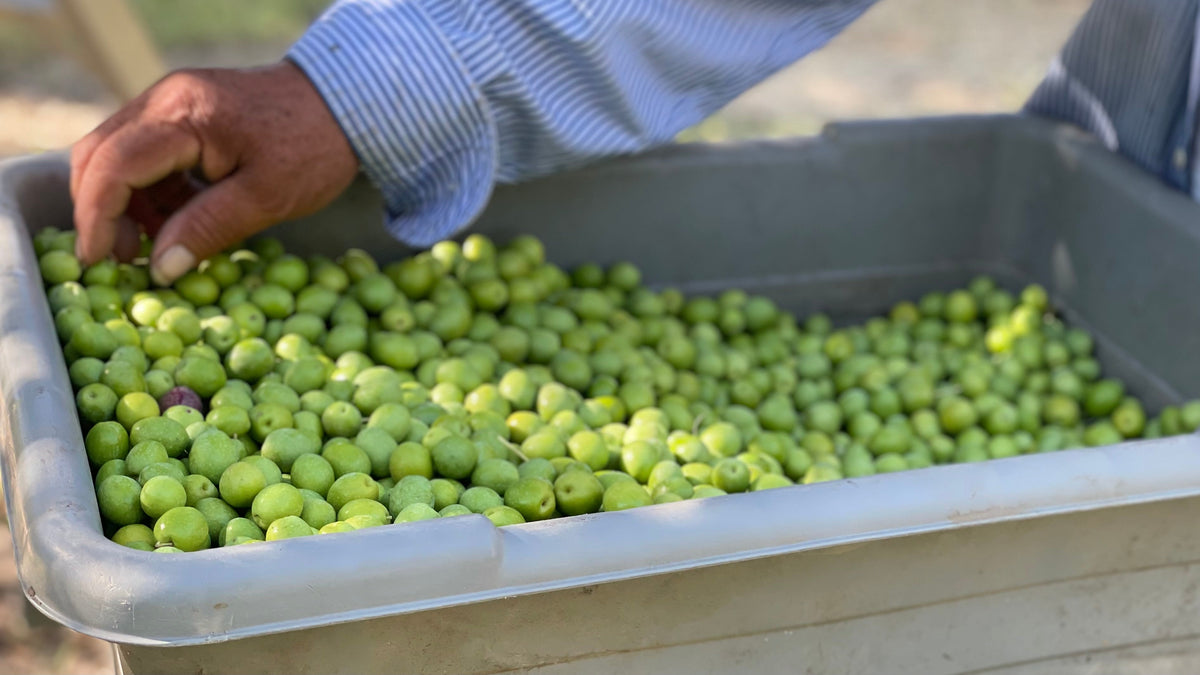
This mid-harvest report follows an unusually complicated 2026 olive season in our small corner of Northern California—from spring bloom through the final green-olive harvest. As of October 10, we have secured sufficient Corning-grown Sevillano and Manzanillo to complete our remaining green-olive backorders.
The observations below represent a fraction of the table-olive and oil-olive acreage in Northern California and should not be read as a report on the California olive industry as a whole.
Olives from Corning, California: A Sense of Place
I'm writing to you from the unincorporated countryside north of Corning city limits, a hamlet—officially a Census Designated Place—called Richfield, home to 309 souls.
Richfield has a significant number of acres planted in almonds, walnuts, prunes, pistachios, and olives. Here, those trees maintained as permanent crops outnumber people roughly 100 to 1.
In all, the surrounding rural county of Tehama boasts nearly 70,000 acres of permanent tree crops, just over 10% of them dedicated to olives. We're situated very close to the principal north-south interstate on the West Coast and only three miles north of the second-largest ripe olive processing plant in the world.
Spring 2026, Terribly Turbulent
Our 2026 growing season began exceptionally early, matching reports from Burgundy in France, the Napa Valley, and other permanent crops throughout the West—cherries, peaches, almonds—that trees were reaching full blossom weeks earlier than in a normal or average crop year. An early bloom naturally pushes the rest of the crop calendar forward as well.
For olive producers in our area, this year's timing meant trees were in full flower by mid-April instead of around Mother's Day, leaving delicate blossoms unusually vulnerable to inclement weather.
Unseasonably warm afternoons in early April accelerated bud break. Moderate rainfall and thunderstorms on April 12 and 13 were followed by thick morning mists that drenched open blossoms, knocking free airborne pollen and interrupting wind dispersal at the onset of full bloom.
A second weather event seven days later delivered localized showers and gusty breezes across the valley floor just as lingering blooms were attempting to complete ovule fertilization.
Mother Nature delivered a coup de grâce in May with isolated showers during the first week, followed by a sharp mid-month cold trough. Blustery valley winds were recorded with gusts exceeding 49 mph, threatening the freshly set, tiny fruits that had survived.
Not all olive varieties or orchards were affected equally—and some seemingly not at all—but the overall impact was felt throughout the grower community.
Summer 2026, Benignly Beneficial
After the turbulent wet bloom window in April, the valley largely avoided the punishing, prolonged triple-digit heat waves that can stall olive cell division.
During June we enjoyed consistent runs in the 80ºF to 90ºF range, frequently between 85ºF and 96ºF, with only one five-day spike from 101ºF to 109ºF. July and August were similar, with relatively few triple-digit days until early August.
The lower fruit load per tree created by the spring weather, combined with the comparatively mild summer, allowed the trees to devote their resources to fewer olives. Fruit developed efficiently, and we began harvest at the end of August rather than after Labor Day.
Table Olive Harvest Begins, Woe Is Manzanillo
As we were finalizing harvest plans, it became clear that Manzanillo would not be available from our regular sources.
There were simply too many “sports” per branch in the orchards we normally use. Sports, sometimes called “shotberries,” are olives that never develop much beyond the size of a BB.
We eventually found excellent substitute fruit from a friend we hadn't seen for more than ten years, and his Manzanillo was terrific. We enjoyed about ten days of fulfillment before the fruit available for fresh shipment fell below our standards and the balance of the crop moved to the canneries.
We searched for another source while another stretch of triple-digit weather passed through the valley.
Then, only a few miles south of us, we found another Corning-grown Manzanillo crop. Astonishingly, the fruit was still golden green with very little blush. When we cut it open, however, the flesh clearly showed oil development—lipogenesis had begun.
That fruit will be used to complete our remaining Manzanillo backorders when packing resumes.
Smaller Sevillano
The Sevillano harvest began August 31 with sound fruit and, during the early weeks, roughly half of the crop sorting into our 24 mm+ Colossal size.
As the season progressed, however, fewer and fewer Colossals appeared in each morning's harvest. By the third week, roughly 90% of the fruit passing across our sizing table measured 18–23 mm—a range spanning the familiar commercial size names Large, Mammoth, Giant, and Jumbo, and the assortment we now call our Jumbo Mix.
Then the Colossals nearly disappeared.
On Sunday, September 27, I printed the week's UPS labels expecting perhaps 10% of the incoming crop to meet our 24 mm+ Colossal specification. In production, the actual share fell below 5%, leaving dozens of Colossal orders unfilled.
Surgery two days later delayed my response to that change, and the heat wave that followed brought harvesting to a temporary stop.

Completing Green Olive Backorders
By late last week, most of the fruit we had been monitoring had moved well beyond the golden green stage. I had begun to believe that a substantial number of customers waiting for green olives would have to be refunded.
Friday evening changed that.
We visited another Corning grower and found sufficient sound, golden green Sevillano and Manzanillo to complete our remaining green-olive backorders.
That resolves the question of whether we have enough fruit by weight. Sevillano size is a separate matter. We will still size and grade the fruit as it moves through the packing line, filling Colossal orders wherever the harvest produces sufficient olives measuring 24 mm and larger.
If an outstanding Colossal order cannot be filled to that specification, we will contact the customer to discuss substituting Jumbo Mix or issuing a refund.
No additional green-olive orders are being accepted. Our focus now is completing the orders already entrusted to us.
Packing will begin with orders for which UPS labels have already been generated, followed by the remaining backlog. Transit time will also influence the daily sequence so customers at the longest UPS Ground distances are not unnecessarily disadvantaged.
Olive Ripeness, Both Inside and Out
An important consideration when packing fresh olives for home curing is the degree of ripeness—both outside and in.
Exterior color tells only part of the story. Cutting the fruit open helps us see how maturity is progressing through the flesh.
The Sevillano shown below remains firm and pale nearly to the pit. The Manzanillo shows substantially more oil development, visible in its yellower, more translucent flesh. That contrast reflects an important difference between the two varieties: Sevillano is exceptionally dense and low in oil, while Manzanillo is a dual-purpose olive capable of developing considerably more oil as it matures.
The two fruits will also cure differently. At this maturity, Manzanillo will generally become more tender and buttery, while Sevillano will retain much of the dense, substantial texture for which the variety is known.

Harvesting Olives for Oil and for “Black” or Ripe Cured Olives
Thus far I've written primarily about two varieties grown principally for table-olive use.
It is possible to mill Sevillano for olive oil, but yields are generally so low that doing so is rarely economical. At Lucero Olive Oil we milled Sevillano twice. The first time we obtained 12 gallons per ton for an Olio Novello; on another occasion the yield was only 6 gallons per ton.
I jokingly refer to that second attempt as my personal best. The oil became a component of the company's 70th Anniversary Blend in 2017.
Compared with an industry average around 35 gallons per ton—or some of our own harvests yielding approximately 45 gallons—Sevillano often doesn't pencil out for a busy olive mill. That gives Corning growers considerable incentive to harvest as much Sevillano as possible for table-olive use before the canneries finish their season.
Manzanillo is different. It is a true dual-purpose olive, valued both for table-olive curing and for its ability to produce substantial quantities of oil. Growers therefore have more options for fruit remaining on the trees later in the season.
Very ripe Manzanillo is one of several oil-rich Corning-grown varieties we are considering for our fresh ripe olive program.
Other Olives — Time for Olio Novello
Depending on olive variety and local conditions, harvesting and milling are already underway across olive-growing regions of the Northern Hemisphere.
There are more than 20 olive varieties available in our area, and in the coming weeks we'll begin assessing our choices for the 2026 Olio Novello.
Green-olive harvest may be nearing its end, but the oil season is only beginning.
I look forward to sharing more soon.